

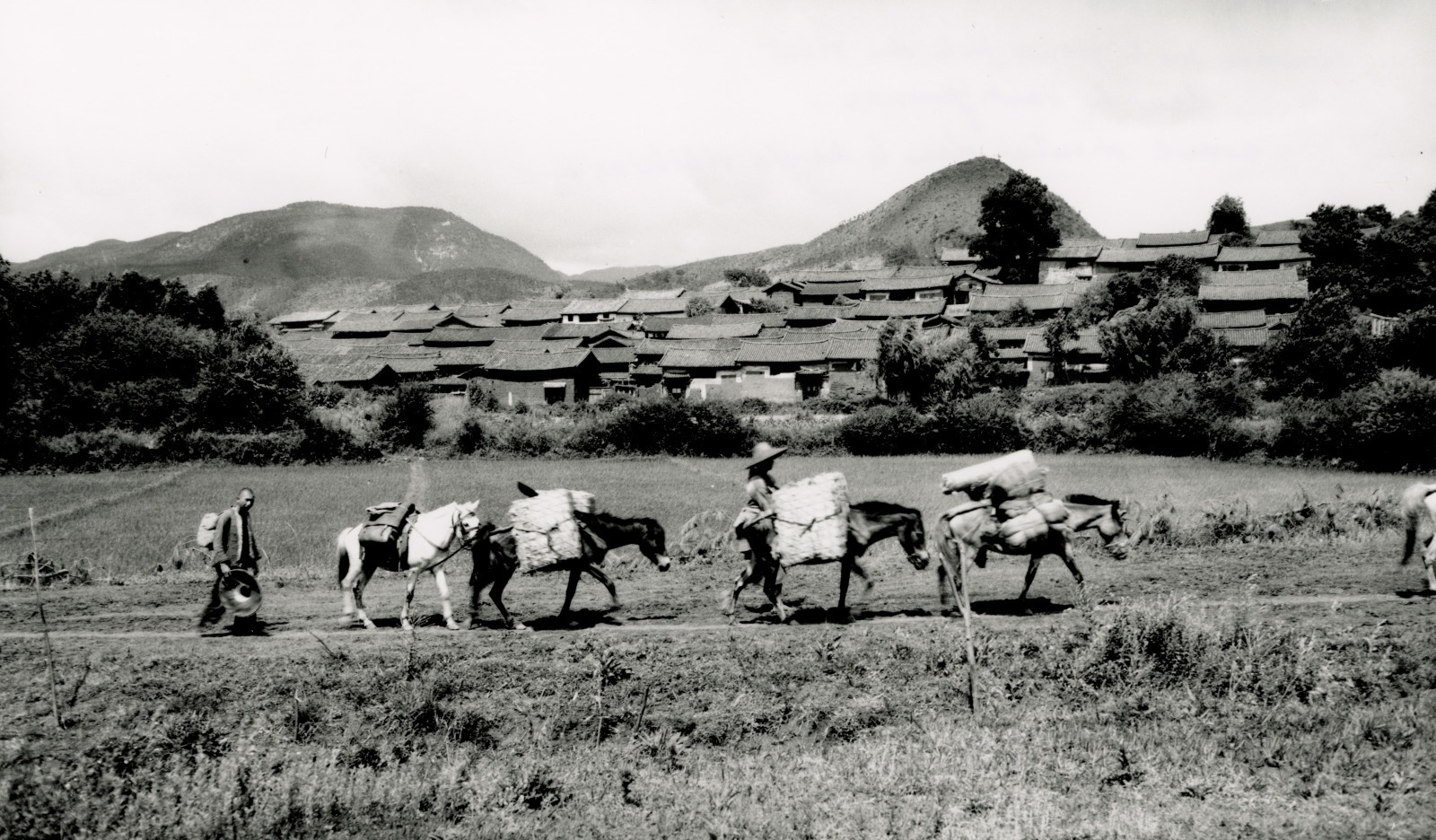
Geographical distribution
The catholic mission in Tibet, started and lead by the priests of the Foreign Missions office of Paris, is divided into three geographical zones distant from each other, each belonging to the tibetan cultural space.
1. the mission’s main zone of deployment: Kham (oriental Tibet), known as the”Tibetan Marches”. Active between 1854 and 1952, the oriental tibetan mission was divided as such:
- the region of Kangding (Tatsienlu) and its peripheral outposts (Moximian, Chapa)
- the border region of Sichuan (Bathang, Yerkalo, Yaregong)
- the tip of the Yunnan province (Cigu, cizhong, Weixi, Xiao Weixi)
- Salouen (Bahang, Kionatang)
2. the mission in Southern Tibet from 1848 to 1854, in the Indian states of Assam and Arunashal Pradesh
3. the mission in the Indian state of Sikkhim from 1880 to 1937, around the cities of Pedong, Maria-Basti, and Kalimpong.
Historical Notice
In the 17th century, portuguese Jesuits attempted to enter Tibet from their outpost in Agra (India). One of them, Antonio de Andrade, sucessfully reached Tsaparang in 1624 and stayed for twenty days. Other expeditions were organized in the following decades. However, no concrete apostolic results came out of them. The Sacred Congregation de Propaganda Fide (SCPF) sends Capuchins in 1722. They succeed in building a chapel in Lhassa, that they abandon in 1747, witnessing little to no conversions to catholicisms. The end of the century marks the strengthening of the Chinese Empire’s military power in the region with troops being deployed to Lhassa, followed by imperial high officials (amban) to organise the tibetan administration, lead by the Cabinet of ministries (kashag) and occupy the governement along side the tibetan ministers (kalons). Following this turn of events, Tibet becomes almost impenetrable to foreign influence.
After the signature of the “unequal treaties” between China and England (Nankin) and France (Huangpu), the SCPF takes advantage of the accords to send its european missionaries. On the 27th of March 1846, it creates the apostolic vicariate of Lhassa and entrusts it to the Foreign Missions of Paris (Missions Etrangères de Paris, MEP). Mgr Pérocheau, then apostolic vicar of the region of Sichuan, recieves its temporary leadership. The territories that constitutes this vast apostolic vicariate are Tibet, the Tibetan Marches and the tibetan speaking regions of northern India (Ladakh, Bhoutan, Nepal, Sikkim). The Congregation’s strategy was to infiltrate Tibet from the border regions with Sichuan and Yunnan. A decade later, Mgr Thomine-Desmazures is designated apostolic vicar of Lhassa. Missionaires are stationed in the semi-independent region of the Tibetan Marches, where they establish their main outposts. Several attempts of further incursions into the tibetan regions end in failure.
Systematic attacks and expulsions force missionaries to explore new border in the southern regions. A first unseccesful attempt is conducted in the border region with Assam. A second attempt near Sikkim results in the creation of small christian communities. However the Indian border reveals itself to be no less impenetrable than the Chinese border.
Confronted with the realities on the ground, Mgr Chauveau, successor to Mgr Thomine, makes the decision in 1868 to establish the apostolic see in Tatsienlou (Kangding), in the territory of the Sichuan mission which had recently joined its apostolic vicareate. The mission of Southern Tibet is neglected for 15 years until the nomination of Mgr Douénel in 1929. In 1937, the MEP in the region are replaced by the Canons of Saint-Maurice. Meanwhile, Mgr Valentin, apostolic vicar residing in Kangding, proposes to Mgr de Guébriant to leave the border outposts of the Tibetan Marches to the Canons of Grand-Saint-Bernard. Indeed, some of their missionaries had been stations in the border region with Yunnan since 1933. The MEP missionaries stationed in the region would recuse themselves from the chinese regions where they had already solidly implanted their outposts. History would decide otherwhise; the rise of communisme in China during the month of october 1950 would bring about the invasion of Tibet. In 1952, all missionaries are exiled from the region.
The Canons Regulars of Grand-Saint-Bernard
Mgr de Guébriant, Superior general of the MEP between 1921 and 1935, seeks the help of the Canons Regulars of Grand-Saint-Bernard, at the request of Mgr Giraudeau. This particular congregation from Switzerland was infact used to the mountanous terrain. In 1929, Mgr de Guébriant asks Mgr Théophile Bourgeois, provost of Canons, to send religious officials on a scouting mission. Two canons join the MEP in Tibet in 1933, followed by three others in 1935 (in Weisi). Among them, Father Maurice Tornay, later assassinated in 1949. In 1934, a groupe of canons arrive in Sikkim. The mission in Sikkim was transfered to the order in 1937 and the Canons estalish themselves first in Pedong, then Maria-Basti, and finally Kalimpong in 1960.
Indicative bibliography
GROS (Stéphane), éd., SCHENDEL (Willem), HARRIS (Tina), collab., Frontier Tibet, patterns of change in the Sino-Tibetan borderlands, Amsterdam University Press, 2019, 554 p.
BRAY (John), « Trade, territory, and missionary connections in the Sino-Tibetan borderlands », p. [151]-178.
DESHAYES (Laurent), Histoire du Tibet, Paris, Fayard, 1997.
DESHAYES (Laurent), Tibet, 1846-1952 : les missionnaires de l’impossible, Paris, Les Indes savantes, 2008.
FAUCONNET-BUZELIN (Françoise), Les martyrs oubliés du Tibet. Chronique d’une rencontre manquée, Paris, Le Cerf, 2012.
FAUCONNET-BUZELIN (Françoise), Les porteurs d’espérance. La mission du Tibet-Sud (1848-1854), Paris, Le Cerf, 1999.
« Missions du Toit du monde », 2 octobre 2012 au 30 juin 2013, catalogue de l’exposition, musée des Missions Etrangères de Paris, MEP, 48 p.